
How Do Airplanes Fly? The Four Forces Explained
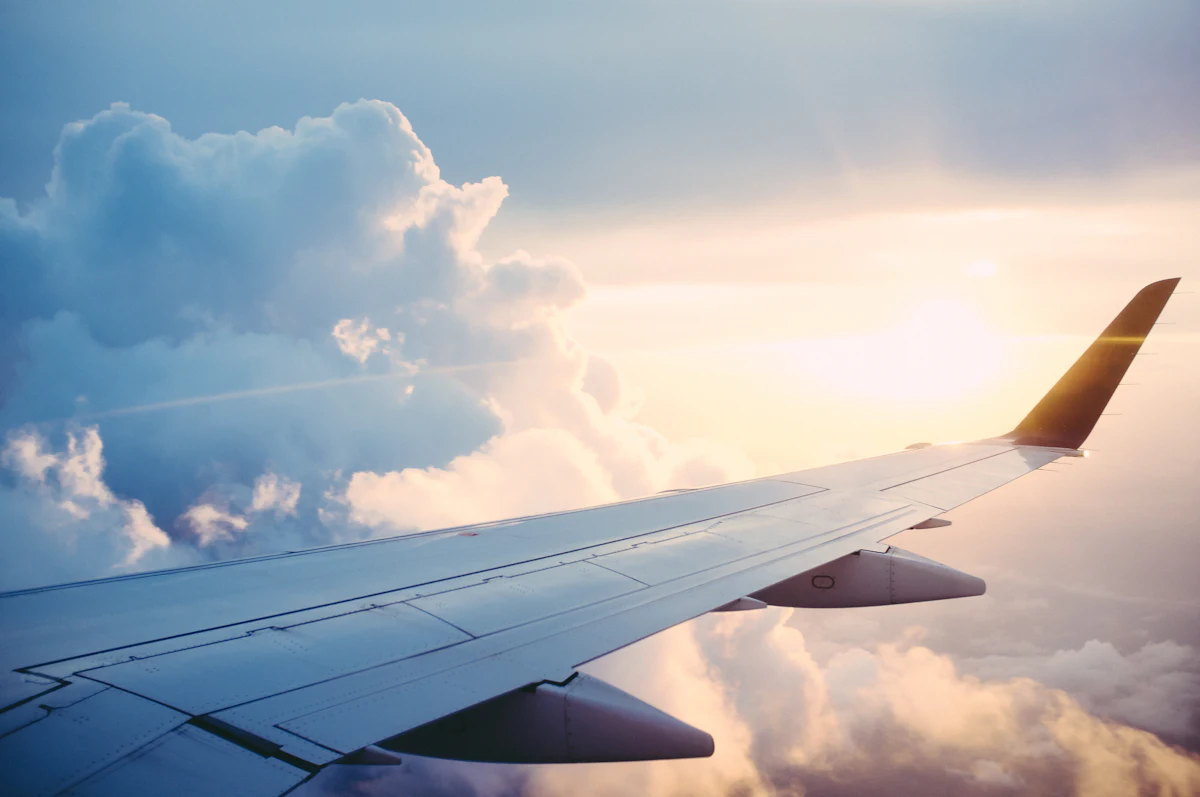
A heavy metal plane stays in the air because of four forces. Learn how wings make lift, and why the popular "air travels faster over the top" story is only part of the truth.
A modern passenger jet weighs hundreds of tonnes. It still glides through the sky for hours. Flying is not magic. It is the balance of four forces.
The four forces
- Weight: gravity pulling the plane toward the ground.
- Lift: the upward force that holds the plane up.
- Thrust: the forward push from the engines or propeller.
- Drag: air resistance that slows the plane down.
In steady flight, lift equals weight, and thrust equals drag. To climb, a pilot increases lift or thrust. To descend, they reduce them.
How wings create lift
A wing is shaped so that, as it moves forward through air, it pushes the air downward. Because every action has an equal and opposite reaction (Newton's third law), pushing air down pushes the wing up. At the same time, the airflow over the curved top of the wing has lower pressure than the air below, which also results in an upward force.
A popular myth
A famous explanation says the air over the top has to travel farther, so it must go faster to "meet up" with the air underneath. That story is wrong. The two air flows do not need to reach the back of the wing at the same time. Aeronautical agencies such as NASA point out that the equal-transit-time idea is incorrect.
What pilots control
Angle of attack
The angle between the wing and the oncoming air. Tilting the nose up raises it and increases lift, up to a limit.
Flaps and slats
Parts of the wing that extend during takeoff and landing, giving more lift at slow speeds.
Ailerons
Hinged panels on the wings that tilt the plane left or right.
Elevators
Panels on the tail that move the nose up or down.
Rudder
A panel on the tail fin that steers the nose left or right.
Why a plane can stall
If the angle of attack becomes too steep, the smooth airflow over the wing breaks up and lift suddenly drops. This is called a stall. It does not mean the engine stops. Pilots are trained to recover from stalls by lowering the nose to regain airflow.
What most people miss
- Planes can glide without engines. Even if all engines fail, a plane can glide for a long distance and land.
- Turbulence is uncomfortable but rarely dangerous. Aircraft are built to handle far more than usual bumps. Keeping your seatbelt fastened is the main safety step.
- Birds, gliders, and jets all use the same principles, only at different scales.

